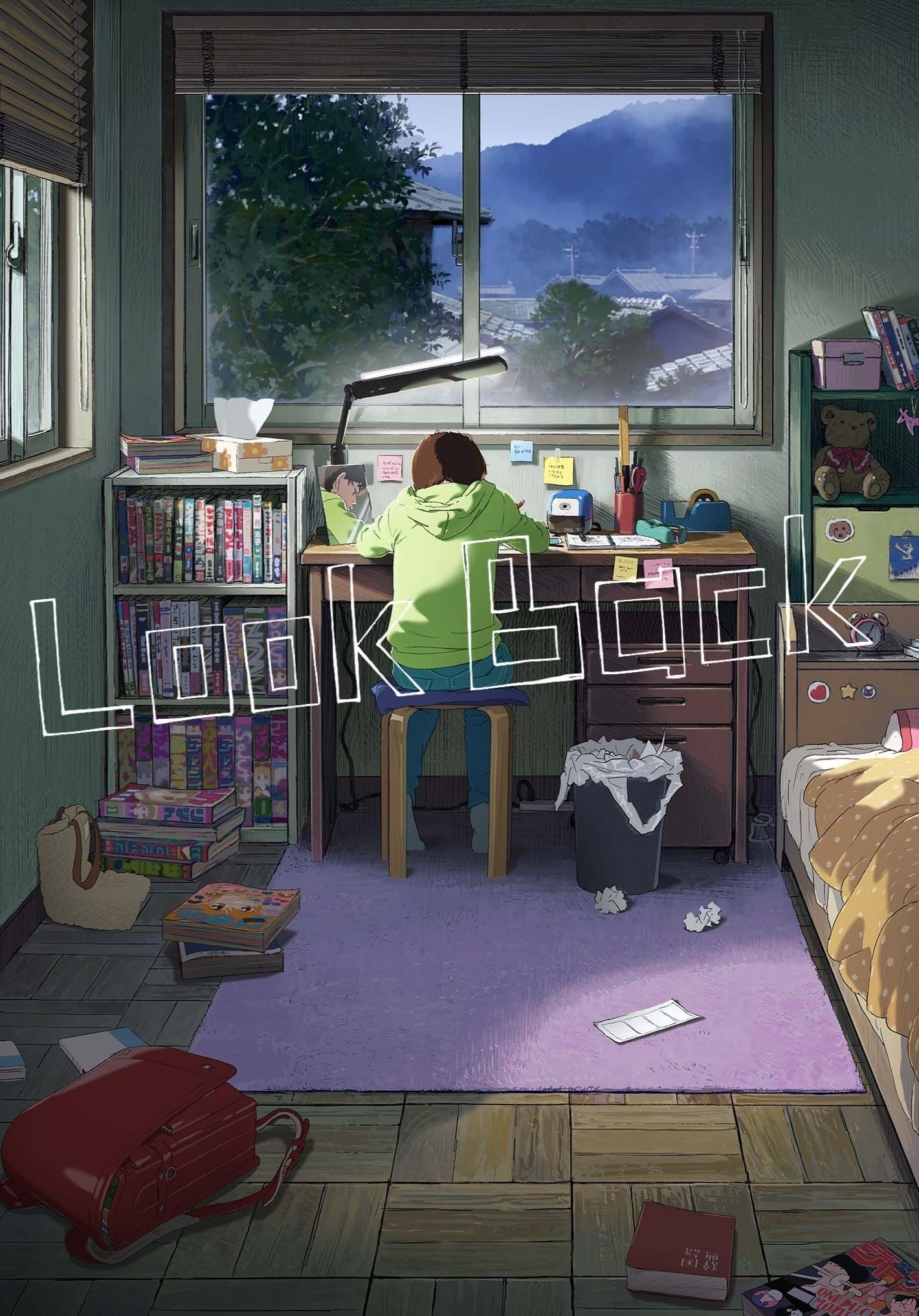
FOR THE LOVE OF ART ITSELF!

This anime adaptation of Tatsuki Fujimoto’s 2021 One-shot manga was directed by Kiyotaka Oshiyama at Studio Durian and was released in 2024.
DARE TO DIRECT
Look Back is one of the most euphoric pieces of storytelling the anime industry has produced this year, a mastercraft from the greatest mangaka of our generation adapted by a set of hands that fundamentally understands it. This was never a work that could gain much from a new perspective and intentions like it’s ancestor Chainsaw Man did under Ryu Nakayama, no this much more grounded story had already been drawn with such precision, such honed intentions that only a faithful to a fault anime could dare match its power, dare to justify its existence. Under Kiyotaka Oshiyama and his Studio Durian staff they would set out to do just that and succeeded overwhelmingly, this is something special if you love animanga this story was made for you.
A MANGA MASTERCLASS
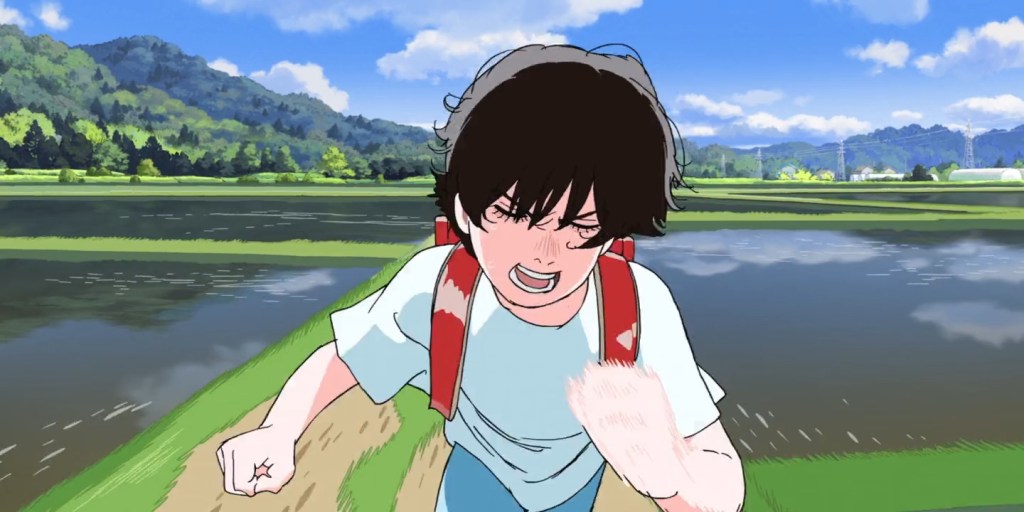
Ok so Look Back, the first one shot of two that Tatsuki Fujimoto did between his star making success CSM. A story about why creatives make art in spite of everything that stands in their way be it societal pressure and inhuman industry practices. A story about what it means to love your art, how that passion can push you to become the most vibrant version of yourself and the people that will become attracted to that. A story grounded by the lived experience of an author whose gone through it all and never fell into complacency, instead pushing the whole medium forward with his unfaltering passion for his art. It starts off simple and grounded, building to a devastating climax that quickly but not too swiftly transitions into a unforgettable twist that reinforces that this is a story meant to inspire its viewers, not eliciting base emotional reactions but a deep and satisfying discussion that burns it forever into the minds of those who love it. On a storytelling front Fujimoto transcends with this work, the chains of weekly serialization shaken off with the final result of a mangaka presenting their work uncompromised. His focus on cinematic flowing paneling, precisely detailed character art that emotes unlike anything he ever did before and the steady controlled pace that those previous elements provide results in a great story told to utter perfection. So, finally, how do you adapt something whose DNA so thoroughly lies in its pen on paper roots?
ADAPTATION 101
By providing a work of animation that displays that same mastery of its own unique medium with a love for the original work that shows through it’s uncompromising commitment to it. If it ain’t broke don’t fix it would be an understatement, Oshiyama’s directorial intentions are so loyal to the work it renders his hand invisible… is what I’d say if this wasn’t such a brilliant anime that his hand only made me love a story more that I really thought possible. Everything about this adaptation works on a level above plain quality, it has it’s own thunderous gravitas that makes even the moments where literally nothing happens land like a sniper’s bullet. From the outset we see him subtly expand the story of the original work to suit his own medium when Fujino, the 4th grade artist that do be our MC, has her 4 Koma manga shown off in the school newspaper. Her classmates are in awe of her abilities and so the anime sees fit to make us feel her position by bringing to life her drawings in a vibrant hilariously wacky style, making this single page of manga a hilarious and memorable minute long sequence. This addition, not even a change per say still manages to improve the original story by further inviting us into its world, immediately making you connect to it.
TAKING AUTHORSHIP
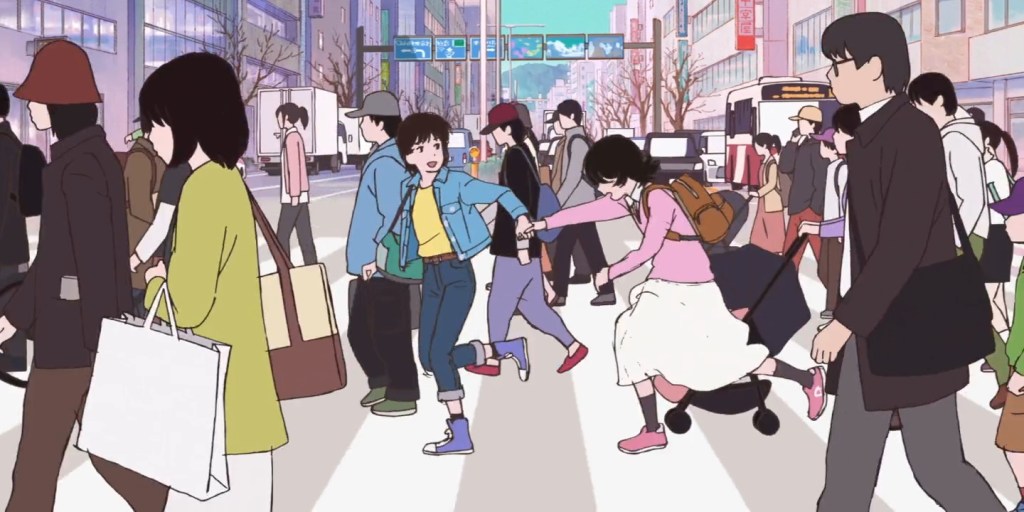
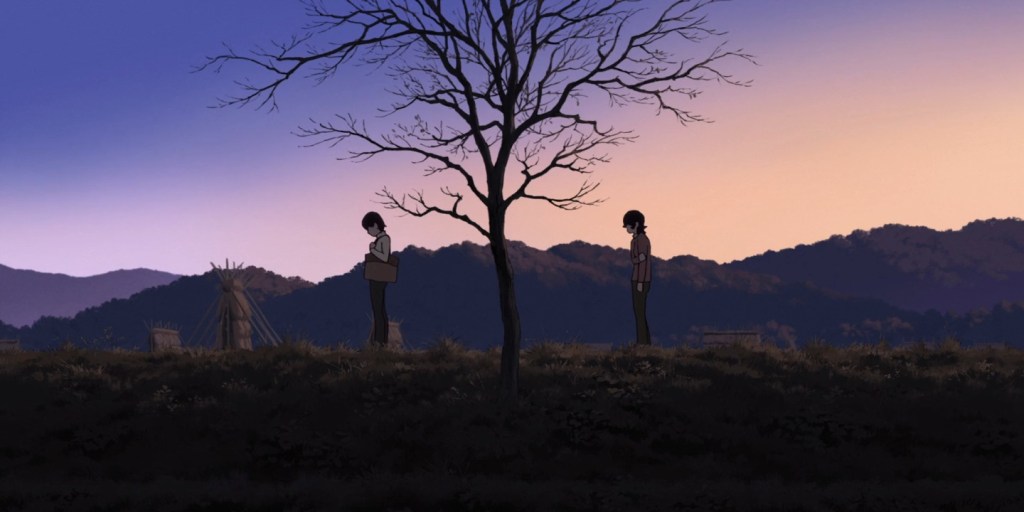
That’s the name of the game of this adaptation, subtle expansions that help bring us more in touch with the feeling of the story without affecting the sharp pace of events. It’s so naturally done that I can’t really give many other examples because it just felt like Fujimoto’s original voice was speaking the whole way through but as that example proves its that Oshiyama did have something to say here, a reason to adapt Look Back and the ability to seamlessly slip into its leading position. And I give that credit to him because he didn’t just direct this but write its screenplay and design its characters on top of an extra involved hand in every other aspect of this production, memorably even stepping in the voice acting booth to help his VA’s match his vision. Oshiyama occupies a position Fujimoto once did and moreso than usual his staff, his unreasonably talented staff(check the credits, holy crap) carry on as assistants to his own work. Tatsuki Fujimoto already received a supremely high level anime adaptation with Chainsaw Man but with his second anime his artstyle, not just his story, has been brought to life with such vivid stylistic cohesion. Oshiyama positively nailed his character designs, the imperfect lines and slightly off expressions being an exact replica of Fujimoto’s own drawings, only enhanced by a soft colour scheme that never feels distracting. The visual palette is warm and stylized through the soft linework and coloration but it never feels poppy or artificial, it’s gorgeous but not in a aggressively vibrant manner. That applies to the painterly background art that doesn’t scream at you but pleases in its own way, I haven’t seen much like it except I have and when you have a staff list full of Heike artists you know you’ve won.
PACING ITSELF
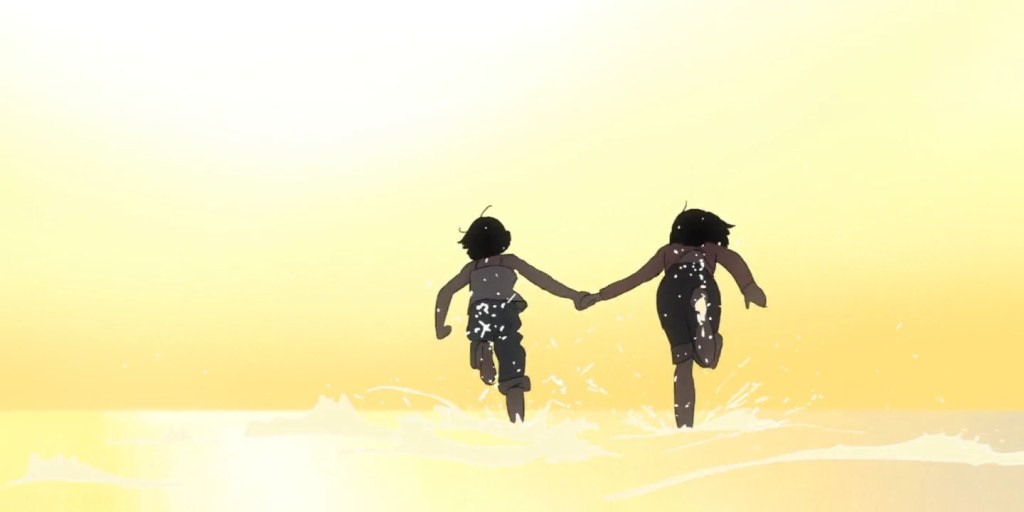
The way this film is edited feels tightly connected to the feel of a manga panel and page turn, it’s snappy just as often as it lets a bigger moment burn itself into your mind. The animation is similarly conscious of the original because there’s a strength in both the stills and movement on a profound level. In moments where Fujimoto’s panelling conveys movement the animation fills in the rest of the page, the joyful swagger of its young leads makes for a natural incorporation of exaggerated character acting like the memorable moment when Fujino regains her desire to draw again, hopping through a downpour with glee. Throughout the manga montages of dialogue free, uniformly rectangular panels serve as the in between heart of this narrative as life marches ever onward, their quietness drawing you into the moment and forcing you to appreciate the drawings in a way manga that throw heaps of dialogue at you just don’t. The anime adapts these sequences diligently, aided by the rhythmic editing and very understated animations these moments are wholly authentic to the original vision but maybe land even better because of anime’s true superpower, sound.
JUST LISTEN TO THE SONG
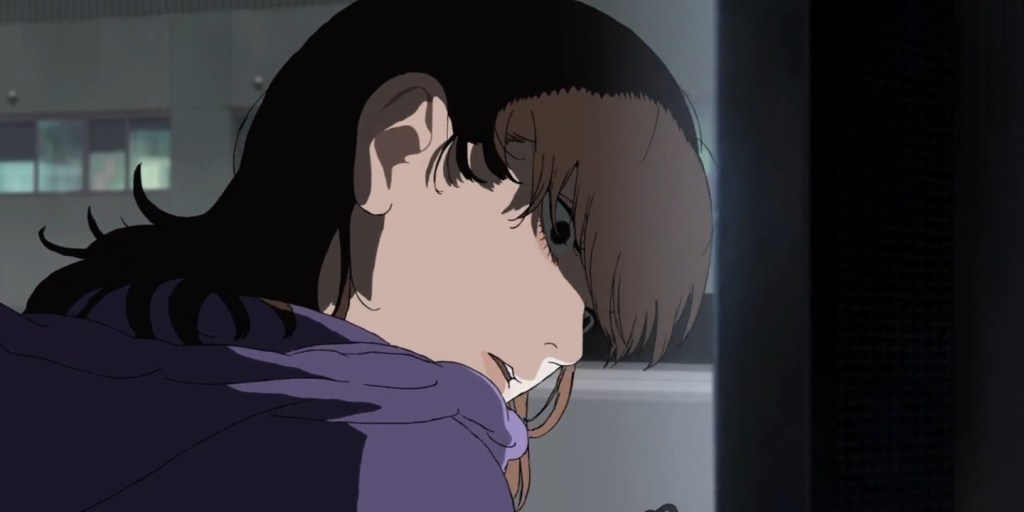
To alot of people an anime adaptation mainly exists to add movement to a work but that’s a take I can never fully agree with even though I won’t dismiss it because to me a well drawn manga should provide the full illusion of movement. A lot of artists sure don’t so it’s not a bad take but Tatsuki Fujimoto is not apart of that group, he stands alongside the likes of Murata and Matsumoto as a creator whose conveyance of movement through still drawings is more real than most animated shows and Look Back was exceptional still in that regard. So sound, as in sfx, score, and obviously vocal performances are the main thing an adaptation of his work can bring to the table and this team knocked it out of the park. Those beautiful still montages, free of all distraction gain a newfound resonance through the gorgeous soundscape composer Haruka Nakamura produced for this anime. On a cinema sound system probably not calibrated well because of the single day showing his score is ear shattering but welcome, the sound so pleasantly atmospheric with its dominant piano that every scene where it confidently grabs central status comes alive as a pure experience. There’s a warmth they never had before and with it their already immersive sensibilities become that bit more welcome and inviting. I brought up sfx like I actually noticed it this time, but eh sfx that’s just good is invisible so mwehahaha it must be good.
DELIVERANCE
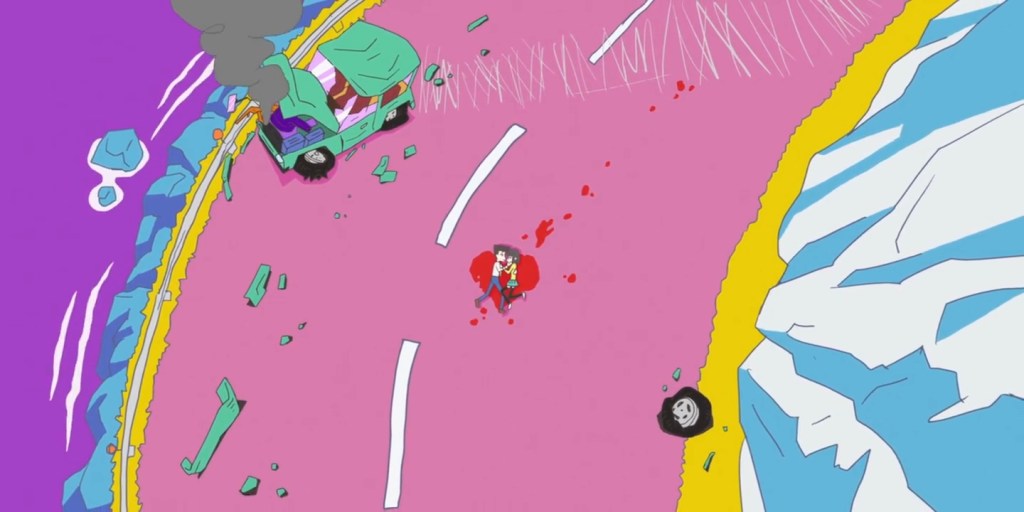
The voice acting was filled out by newcomers Yumi Kawai as Fujino and Mizuki Yoshida as Kyomoto and both provided the realistic performance Oshiyama picked them for, their emotions always ring true whether it be happy banter and more biting viscous scenes, it’s the type of understated delivery that only heightens the material. But the mastery of sound this production clearly has has no greater example than in the climactic gutpunch that brutally removes it all which alongside the still image’s make it a moment where time stops, terrifically conveying the shock Fujino goes through. It’s uncomfortably silent, uncomfortably drawn out, uncomfortably dark visually, a moment of pure harsh brilliance that lands with clinically explosive effect. The follow through of that moment, the final act that takes this story and flips the script on everything its done thus far to land on an ending of ultimate catharsis only serves to complete this irrististible package. It’s so excitingly written, with a passion for storytelling both conventional and subversive all blended together into a rollercoaster of a drama that lands every dramatic beat it tries with confidence and cohesion.

LOOKING BACK
The self references to Fujimoto’s own work from Fire Punch art appearing in a book of background art to just everything about the main duos manga Shark Kick, always a cheeky nod to Chainsaw Man with it’s covers, get heightened further by Oshiyama who even added some inside drawings which clearly display panels that reflect sequences like Denji’s first death to his meeting with Reze. It’s a addition by him that only rewards those who love the original author like he does and it just makes me smile seeing someone show their adoration like that. Look Back never needed an anime, as far as manga craftsmanship goes it’s a flawless product but manga is manga and anime is anime. This adaptation leverages its mediums strengths to their fullest, subtly expands its source all while perfectly capturing the tone and pace that make Fujimoto works unrivalled in readability. It’s richer, flashier, punchier, and ultimately greater for everything it accomplished.
TIS THE END!
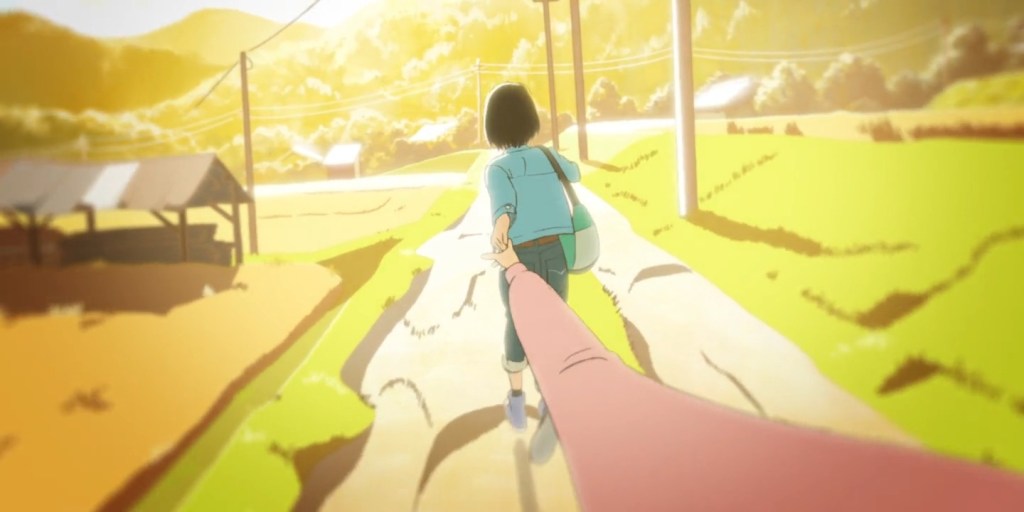
Look Back, Tatsuki Fujimoto‘s semi autobiographical love letter to his medium of choice made the leap to animation under Kiyotaka Oshiyama and pulled off the impossible feat of surpassing it’s own potential, staying irrationally true to itself and absolutely flexing the power of animation to the fullest. I love you Fujimoto, Oshiyama, and everyone at Studio Durian, your art has exactly the effect this film wishes to instil upon its viewers and I hope its massive acclaim across both versions further inspires your own dedication to the craft. And that my friends is why Look Back is the best animated feature of the year so yes, watch it, watch it with haste!
FINAL RATING: 9/10
Look Back can currently be streamed on Amazon Prime or purchased as a single volume from Viz.

 The Manga Meets Moron Blog